
SALC’s seat at the table — and how we’re making sure local voices are heard
Local Government Reorganisation (LGR) is one of the most significant changes to local government in Suffolk for generations. The detail is still emerging, but the direction of travel is clear: decisions made now will shape how local services, local democracy and community leadership work in the years ahead. SALC is working hard to ensure that the voices of parish councils, town councils and parish meetings are heard throughout the process.
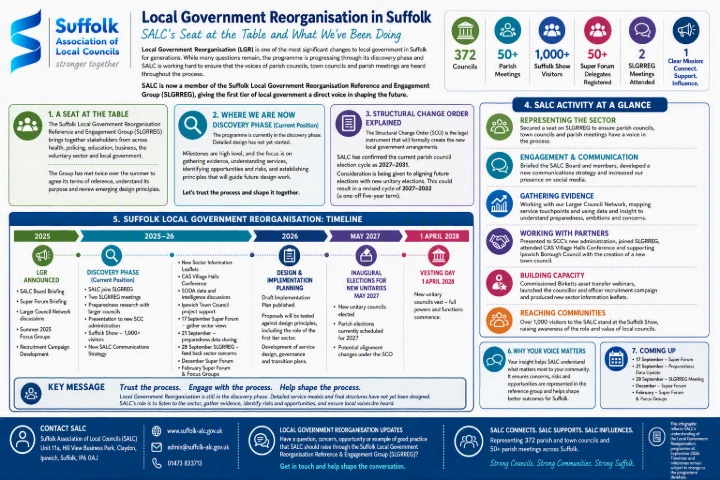
SALC is now a member of the Suffolk Local Government Reorganisation Reference and Engagement Group (SLGRREG), giving the first tier of local government a direct voice in shaping the future.
Securing a Voice for the First Tier
The SLGRREG brings together stakeholders from across Suffolk, including representatives from health, policing, education, business, the voluntary sector and local government. Its role is to provide feedback, identify opportunities and risks, and help ensure community voices are reflected in the development of Local Government Reorganisation.
Over the summer, the group has met twice to agree its Terms of Reference, understand its role within the programme, review the emerging design principles being developed through the discovery stage and comment on the communication strategy.
For SALC, securing a seat at this table is important. It gives parish councils, town councils and parish meetings a direct route into the conversation at a time when decisions are beginning to be shaped.
Understanding Where We Are
One of the most important messages (at the time of writing this update) we want to communicate is that the programme is not quite at the detailed design stage.
While there is understandable interest in what future council structures might look like, the current phase is focused on analysing a huge amount of evidence that has been gathered, understanding existing services, identifying opportunities and risks, and developing the principles that will guide future design work.
The milestones currently available remain high-level and many detailed decisions have yet to be made.
As a sector, it is important that we avoid jumping to conclusions and instead trust a process that is intended to be evidence-based. When detailed design work begins, proposals will be tested against agreed principles, including how local communities and the first tier of local government will be supported and engaged.
The publication of the implementation plan will provide much greater detail and help explain how the programme intends to move from discovery into delivery.
What Is a Structural Change Order?
Over the summer, Suffolk's principal authorities have been working with central government on the drafting of the Structural Change Order (SCO).
The SCO is the legal mechanism that formally creates the new local government arrangements. It sets out how the transition will take place, including governance arrangements, elections, powers, responsibilities and the transfer of functions from existing councils to the new authorities.
As part of this work, SALC has been asked to provide information regarding parish council election cycles across Suffolk.
We have confirmed that the current cycle is 2027 to 2031 and to maintain alignment with elections for the new unitary authorities, consideration is being given to extending the 2027 parish council term by one year, resulting in a revised cycle of 2027 to 2032.
This remains part of the wider discussions around the Structural Change Order and we will share updates as more information becomes available.
What Has SALC Been Doing?
Since the announcement of Local Government Reorganisation, SALC has been actively working to support, inform and represent the sector.
Our activities have included:
- Briefing the SALC Board and members through our Super Forum network.
- Engaging with our Larger Council Network to understand preparedness, ambitions, concerns and opportunities.
- Joining the Suffolk Local Government Reorganisation Reference and Engagement Group.
- Presenting to Suffolk County Council's new administration following the May elections on the role and importance of the first tier sector.
- Developing an overview of the touchpoints between parish and town councils and wider local government services.
- Gathering evidence and intelligence on preparedness across Suffolk's larger councils.
- Designing a new SALC communications strategy to improve information sharing, marketing and social media engagement.
- Agreeing project support with Ipswich Borough Council to assist with the creation of a new town council.
- Meeting with the SODA team to explore how wider datasets can be combined with SALC intelligence to support evidence gathering and storytelling.
- Attending the Suffolk Show to engage with members of the public, organisations, businesses and district and county councillors on the role of the first tier of the public sector.
- Attending the Community Action Suffolk Village Halls Conference to engage with communities and stakeholders.
- Commissioning Birketts, with whom we have a long-standing relationship, to deliver specialist webinars on asset transfer opportunities and considerations for local councils.
- Convening a further Larger Council Network meeting to obtain up-to-date information on preparedness, opportunities, ambitions and concerns arising from reorganisation.
Visit our dedicated project page using this link.
Visit the Suffolk LGR hub website using this link.
We will be providing regular updates now this project is moving into design stage.